




The ICC Men’s Cricket World Cup 2027 is set to take ODI cricket into a new era. Hosted jointly by South Africa, Zimbabwe and Namibia, the tournament will bring 14 teams together across 12 venues for 57 matches from 2 October to 21 November 2027. It will also mark the World Cup’s return to Africa for the first time since 2003.
For Indian cricket fans, the tournament already has several headline fixtures. India will open their campaign against defending champions Australia in Cape Town, face Pakistan at Johannesburg’s iconic Wanderers Stadium three days later, and finish the Group Stage against Zimbabwe at the new Mosi-oa-Tunya Stadium near Victoria Falls.
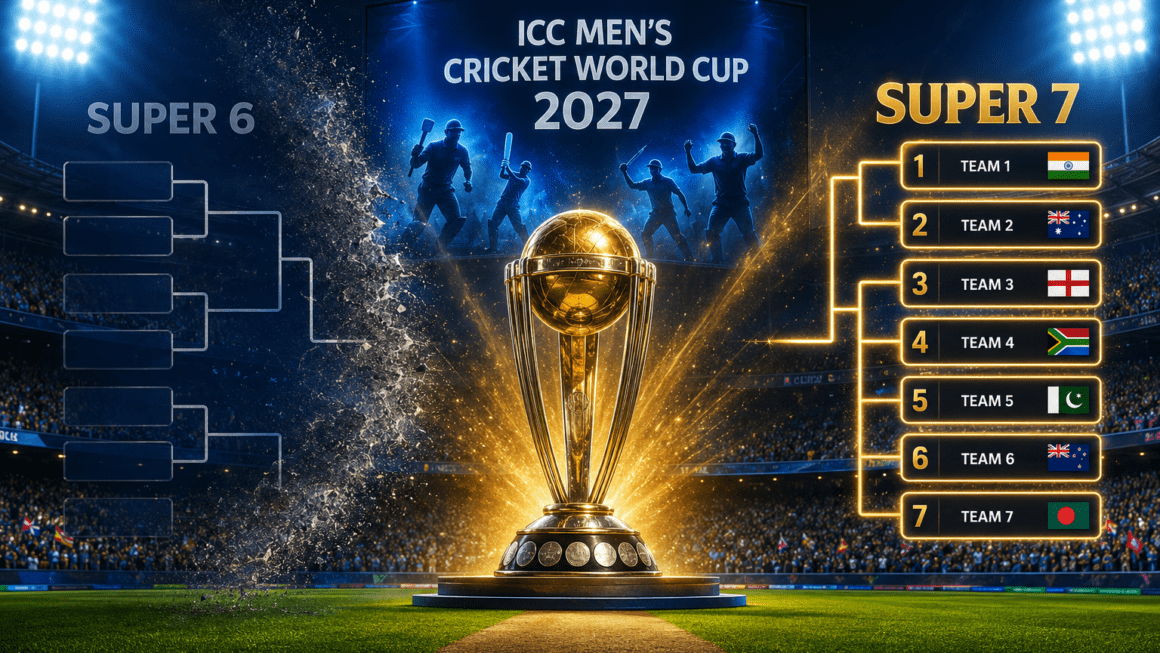
But the most important change is not simply where the matches will be played. The 2027 World Cup introduces a three-stage competition structure, including the new Super 7 phase. That format could make every group match strategically important while ensuring that the tournament remains highly competitive deep into November.
Here is everything cricket fans need to know.
ICC Cricket World Cup 2027: Quick Facts
- Dates: 2 October–21 November 2027
- Hosts: South Africa, Zimbabwe and Namibia
- Teams: 14
- Matches: 57
- Venues: 12
- Group Stage: Two groups of six
- Super 7: Seven-team single round robin
- Semi-finals: 17 and 18 November
- Final: 21 November, Johannesburg
- Defending champions: Australia
- India’s Group: Group A
- India’s group opponents: Australia, Pakistan, Afghanistan, Zimbabwe and Qualifier A
How Does the ICC World Cup 2027 Format Work?
The 2027 edition expands the World Cup from 10 teams to 14 and introduces three competitive stages before the semi-finals.
Stage 1: Super Series
The tournament begins in Namibia with a three-team Super Series.
The second-, third- and fourth-placed teams from the preceding Cricket World Cup Qualifier will play each other once. The team finishing top of this mini round-robin advances into the main Group Stage. The three matches are scheduled for 2, 4 and 6 October in Windhoek.
This opening phase gives the qualification pathway an additional competitive layer rather than allowing a single match to determine the final entrant.
Stage 2: Group Stage
The main tournament then features 12 teams divided into two groups of six.
Group A
- India
- Australia
- Pakistan
- Afghanistan
- Zimbabwe
- Qualifier A
Group B
- New Zealand
- South Africa
- Sri Lanka
- England
- Bangladesh
- Qualifier B
Each team plays every other side in its group once, giving every team five Group Stage matches.
The qualification equation is particularly interesting: the top three teams from each group advance, along with the better-performing fourth-placed team across the two groups.
That means finishing fourth does not necessarily end a team’s campaign. Net run rate and results elsewhere can remain relevant right until the final Group Stage matches.
What Is the Super 7 Stage?
The Super 7 is the defining feature of the 2027 World Cup format.
Seven teams enter this phase and play a complete single round robin. Since every side faces six opponents, the stage consists of 21 matches. Unlike some previous tournament structures, no Group Stage points are carried forward. Every team therefore begins the Super 7 with a clean points slate.
The top four then qualify for the semi-finals:
- 1st vs 4th
- 2nd vs 3rd
The system creates an intriguing tactical dynamic. A team can dominate its group and still need to rebuild momentum in the Super 7, while a side that scrapes through the Group Stage gets a genuine second opportunity to challenge for the title.
India, Australia, Pakistan, England, New Zealand, South Africa and Sri Lanka have been pre-seeded into Super 7 positions for scheduling purposes. If another team qualifies in place of one of those sides, it assumes that team’s designated position. The seeding is intended to provide greater certainty around fixtures and venues without changing the qualification process itself.
ICC World Cup 2027 Venues
The tournament will span three countries and 12 venues.
South Africa
South Africa provides eight venues:
- Wanderers Stadium, Johannesburg
- Centurion, Tshwane
- Newlands Cricket Ground, Cape Town
- Kingsmead Cricket Ground, Durban
- St George’s Park, Gqeberha
- Mangaung Oval, Bloemfontein
- Boland Park, Paarl
- Buffalo Park, KuGompo City (formerly East London)
Zimbabwe
Zimbabwe will stage matches at:
- Harare Sports Club, Harare
- Queens Sports Club, Bulawayo
- Mosi-oa-Tunya International Cricket Stadium, Victoria Falls
The Victoria Falls venue adds one of the tournament’s most distinctive settings and will host India’s final Group Stage match against Zimbabwe.
Namibia
Namibia’s capital, Windhoek, will host the Namibia Cricket Ground.
It will stage all three Super Series matches and three Group Stage fixtures, marking Namibia’s first time hosting matches at a senior men’s Cricket World Cup.
India’s ICC Cricket World Cup 2027 Schedule
India have been placed in Group A and have five scheduled Group Stage matches.
| Date | Match | Venue |
|---|---|---|
| 7 October 2027 | India vs Australia | Cape Town |
| 10 October 2027 | India vs Pakistan | Johannesburg |
| 14 October 2027 | India vs Afghanistan | Tshwane |
| 17 October 2027 | India vs Qualifier A | Bloemfontein |
| 24 October 2027 | Zimbabwe vs India | Victoria Falls |
India vs Australia — 7 October, Cape Town
India’s World Cup begins with a heavyweight contest against Australia, the reigning champions and India’s opponents in the 2023 World Cup final.
The match at Newlands immediately gives India’s campaign a high-profile test. It is also a rematch of the previous World Cup final, adding historical context without making the result any less important than the four other Group Stage matches.
For India, the early challenge will be adapting quickly to South African conditions while managing the tactical demands of a 50-over contest.
India vs Pakistan — 10 October, Johannesburg
Three days later comes arguably the most anticipated fixture of India’s Group Stage.
India vs Pakistan will be played at the Wanderers Stadium on 10 October. The venue will also host the 2027 World Cup final, making Johannesburg a particularly important stop for Indian supporters.
Beyond the rivalry, the match has practical tournament significance: with only five Group Stage games, every result contributes directly to India’s qualification position.
India vs Afghanistan — 14 October, Tshwane
Afghanistan have developed into a formidable force in ODI cricket, particularly through their spin resources and increasingly experienced core.
The Tshwane match therefore offers a very different tactical examination from the Australia and Pakistan fixtures. India’s ability to construct an innings against quality spin and control the middle overs could become an important subplot.
India vs Qualifier A — 17 October, Bloemfontein
India’s fourth Group Stage match will be against the team designated Qualifier A.
The identity of that opponent is not yet known because the qualification process determines the final teams. That uncertainty makes this fixture particularly interesting from a preparation perspective: India’s coaching staff will eventually have to tailor plans to a team whose strengths cannot yet be identified.
India vs Zimbabwe — 24 October, Victoria Falls
India’s final Group Stage match is against co-hosts Zimbabwe at the Mosi-oa-Tunya International Cricket Stadium in Victoria Falls.
It is scheduled as the final Group Stage fixture of the tournament and will be the first Cricket World Cup match at the new Victoria Falls venue.
By then, the qualification picture could be considerably clearer, but the match remains significant because the better fourth-placed team across the two groups can also qualify for the Super 7.
What India’s Preparation Could Look Like
The preparation window is already beginning to take shape.
India’s 2026-27 home schedule includes ODI series against the West Indies, Sri Lanka and Zimbabwe, while the team also has a substantial Test programme against Australia. The BCCI’s published calendar includes three ODIs against West Indies in September-October 2026, three against Sri Lanka in December and three against Zimbabwe in January 2027.
The ICC has also reported that India’s coaching staff views the current ODI programme as part of the build-up to the World Cup. Bowling coach Morne Morkel said in September 2026 that maintaining standards needs to begin well before the tournament itself.
That preparation will have several obvious analytical priorities:
- Top-order stability: India will need reliable starts while retaining enough acceleration for the final 15 overs.
- Middle-overs control: Matches in southern African conditions can place a premium on strike rotation, wicket preservation and adaptable batting.
- Bowling balance: The combination of pace, spin and all-round options will need to work across different venues.
- Fielding efficiency: In a tournament where qualification margins may be tight, preventing boundaries and converting half-chances can have substantial value.
- Squad depth: The Super 7 requires six additional matches after qualification, making workload management and bench strength important.
India’s ODI batting depth is already drawing statistical attention. In the ICC’s 30 September 2026 ODI rankings update, Shubman Gill was ranked No. 1 among ODI batters, while Virat Kohli was second, following centuries against the West Indies.
Of course, rankings more than a year before a World Cup should be treated as a snapshot rather than a prediction. Form, injuries, selection and conditions can all reshape a squad before the tournament begins.
Why the 2027 World Cup Format Matters
The 2027 structure reflects a broader evolution in international cricket: expanding participation while trying to preserve high-stakes matches throughout the competition.
The addition of the Super 7 means the tournament does not simply build toward the semi-finals; it creates another substantial competitive phase after the Group Stage.
For fans, that could make the tactical story particularly compelling. A side cannot rely solely on a strong opening phase. Once the Super 7 begins, every team has six fresh matches and no points carried forward.
That combination of 14 teams, 57 matches, three countries and three competitive stages gives the 2027 World Cup a distinctly different shape from the 10-team editions of 2019 and 2023.
Final Word
The ICC Men’s Cricket World Cup 2027 promises a fascinating blend of traditional rivalries and a significantly redesigned tournament structure.
For India, the road begins in Cape Town against Australia, runs through blockbuster encounters with Pakistan and Afghanistan, and ends the Group Stage at Victoria Falls against Zimbabwe. But the bigger story could be what happens after those five matches: qualification for the Super 7 resets the points race and creates six more opportunities to reach the semi-finals.
With the tournament returning to Africa and a new seven-team phase changing the strategic landscape, there will be plenty for cricket analysts and fans to debate long before the first knockout match.
Which India fixture are you most looking forward to — Australia, Pakistan, Afghanistan, the Qualifier A match or Zimbabwe? Share your thoughts in the comments and pass this guide on to fellow cricket fans as the countdown to World Cup 2027 begins.