





The ICC Men’s Cricket World Cup 2027 is no longer following the format that was originally planned.
Instead, the International Cricket Council (ICC) has unveiled a completely revamped tournament structure featuring a brand-new Super Series and Super 7 stage. While the tournament will still feature 14 teams, the path to becoming world champions has changed dramatically.
For cricket fans, this raises several important questions:
- What exactly is the Super 7?
- Why was the Super 6 removed?
- How does the fourth-placed team now qualify?
- Does this increase the chances of India vs Pakistan clashes?
- Is this change about improving cricket—or improving television ratings?
In this detailed CricFables analysis, we’ll break down everything you need to know.
What Was the Original 2027 World Cup Format?
When the ICC first announced the return of a 14-team World Cup, the competition was expected to resemble the 2003 Cricket World Cup.
The original structure looked like this:
- Two groups of 7 teams
- Every team plays six group matches
- Top 3 teams from each group qualify
- Six teams enter the Super 6
- Top four progress to the semi-finals
The Super 6 stage only included the best three teams from each group, with qualifying teams carrying forward certain results before facing opponents from the other group.
It was relatively straightforward and rewarded consistency throughout the tournament.
However, that plan has now been replaced.
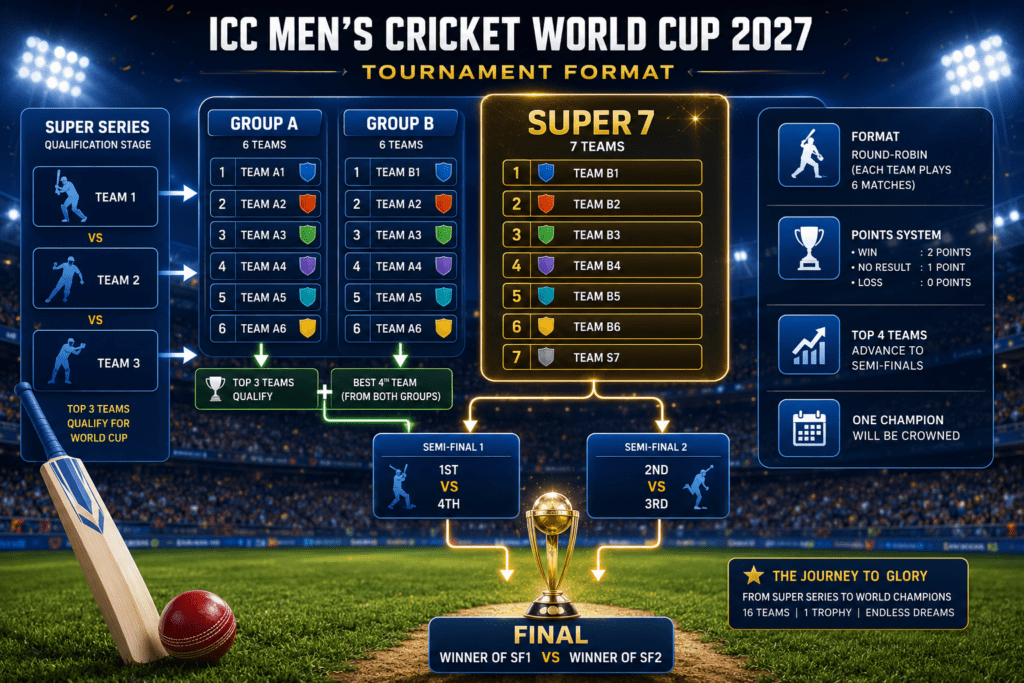
The New ICC World Cup 2027 Format Explained
According to the ICC’s official announcement, the tournament will now feature three competitive stages before the knockout rounds, creating a longer qualification pathway and more matches between top teams.
Stage 1: Super Series
Before the main tournament even begins:
- The three lowest-ranked qualified teams play each other.
- They compete in a mini round-robin.
- Only one team qualifies for the next stage.
- The other two teams are eliminated.
This immediately raises the stakes for lower-ranked nations, as one poor performance can end their World Cup campaign before reaching the main group stage.
Stage 2: Group Stage
The remaining 12 teams are divided into:
- Group A – 6 teams
- Group B – 6 teams
Each team plays five matches.
Now comes the biggest change.
Instead of only the top three teams from each group advancing:
- Top 3 teams from Group A qualify.
- Top 3 teams from Group B qualify.
- Plus the best-performing fourth-placed team across both groups.
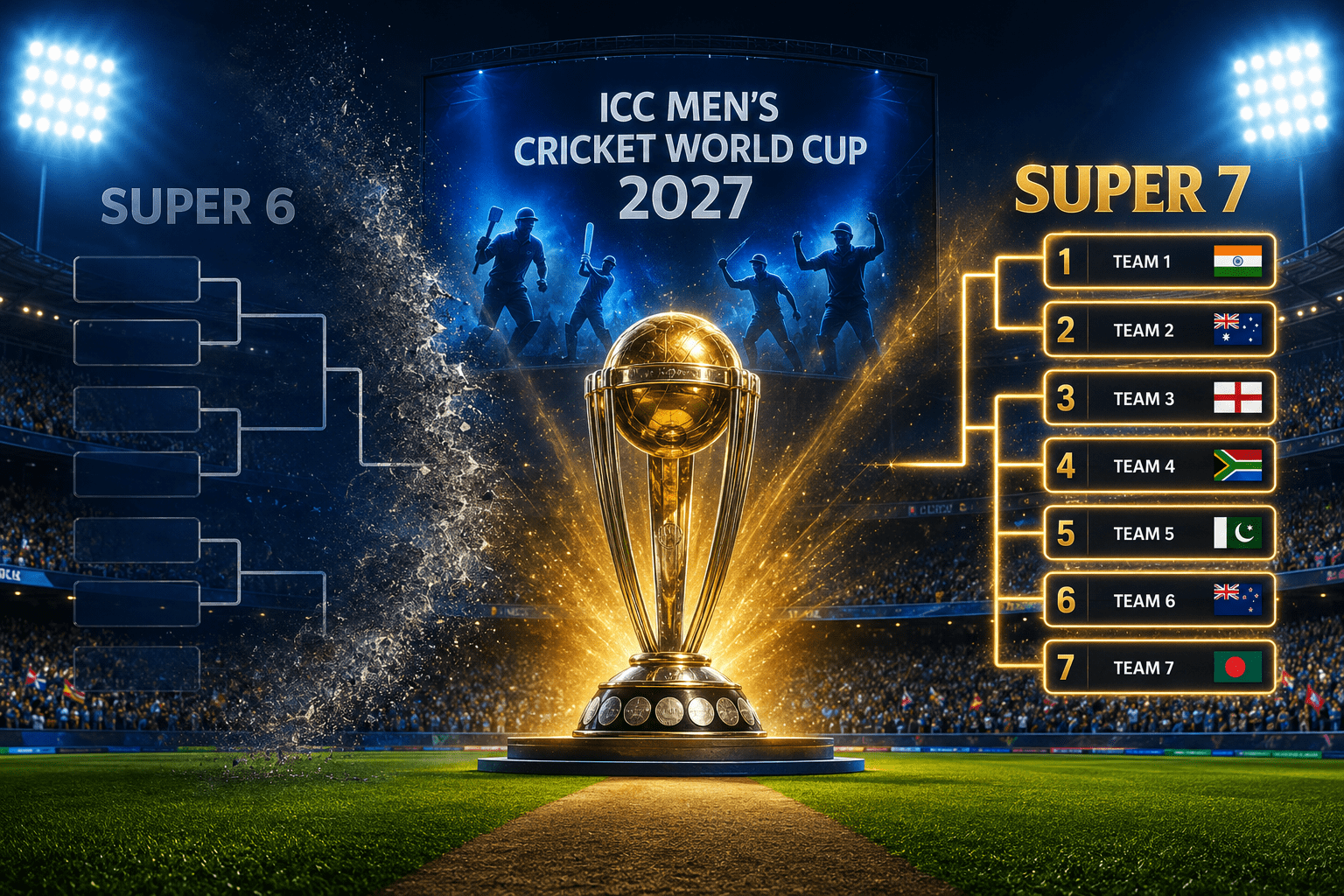
That creates a Super 7 instead of the traditional Super 6.
What Is the Super 7?
The Super 7 is essentially a league stage featuring the seven best teams remaining in the tournament.
Every team plays every other team once.
That produces:
- 21 matches
- One combined points table
- Top 4 teams qualify for the semi-finals
Unlike previous Super 6 formats, the addition of a seventh team creates extra fixtures and more opportunities for heavyweight contests.
How Does the Fourth Team Qualify?
This is arguably the most significant structural change.
Previously:
- Only the top three teams from each group advanced.
Now:
- The highest-ranked fourth-placed team across both groups also progresses.
Example
Imagine:
Group A
- India
- Australia
- England
- New Zealand
Group B
- Pakistan
- South Africa
- Sri Lanka
- Afghanistan
If New Zealand finishes fourth with a better net run rate or more points than Afghanistan, New Zealand qualifies as the seventh team.
That means finishing fourth is no longer automatically the end of the road.
This makes every group-stage match even more valuable, as teams may still have a realistic chance of progressing despite missing the top three in their group.
Why Did the ICC Introduce the Super 7?
The ICC says the revised structure is designed to create more meaningful contests, strengthen competition, and improve the tournament experience by ensuring higher stakes throughout the event.
However, many analysts have suggested there are additional commercial motivations behind the change.
1. More High-Profile Matches
A Super 7 guarantees:
- More games between elite teams
- Fewer one-sided fixtures
- Longer involvement for stronger cricket nations
Instead of moving directly into semi-finals after a smaller intermediate stage, the leading teams now face each other in a larger round-robin, increasing the number of premium contests.
2. Greater Chance of India vs Pakistan
Although the ICC has not stated that the format was created specifically to produce more India–Pakistan matches, the new structure undeniably increases the possibility.
Under the revised format, the rivals could potentially meet:
- During the group stage
- Again in the Super 7
- Once more in the semi-final or final if both continue progressing
It’s important to distinguish possibility from certainty. The format does not guarantee multiple India–Pakistan games, but it expands the number of pathways through which they could happen.
3. Broadcaster Value
High-profile matches consistently attract:
- Massive television audiences
- Record streaming numbers
- Higher advertising revenue
- Increased sponsorship value
India–Pakistan fixtures are among the most watched sporting events in the world, making additional marquee contests commercially attractive for broadcasters and tournament stakeholders. While this commercial incentive is widely discussed, the ICC’s official rationale focuses on competitiveness rather than broadcast revenue.
How Does This Affect Teams?
The new format changes tournament strategy significantly.
Teams Cannot Relax
Previously, finishing third was enough.
Now:
- Even fourth place may be sufficient.
- Net Run Rate could become even more important.
- Every run and wicket may influence qualification.
Strong Teams Get More Opportunities
Traditional cricket powers now have a slightly larger margin for recovery after an early upset.
One unexpected defeat may no longer eliminate them from contention for the next stage.
Associates Face a Tougher Path
One of the most debated aspects of the new structure is its impact on emerging cricket nations.
The newly introduced Super Series requires the three lowest-ranked qualified teams to fight for just one place in the main tournament, effectively reducing opportunities for those sides to face Full Members on the biggest stage. The World Cricketers’ Association (WCA) has questioned the decision and argued that it limits exposure for Associate nations
Advantages of the Super 7 Format
More meaningful matches
With seven strong teams competing in one league table, almost every game could influence semi-final qualification.
Higher quality cricket
Fans are likely to see more contests between the world’s best ODI sides.
Reduced dead rubbers
Because four semi-final spots remain available until late in the Super 7, more matches should retain significance deep into the tournament
Potential Criticisms
Despite its benefits, the format has drawn criticism.
Complexity
Compared with traditional group-stage tournaments, the route to the semi-finals is now more complicated for casual fans to follow.
Tougher for Smaller Nations
Associate teams face an additional qualifying hurdle through the Super Series, reducing their guaranteed exposure in the main competition.
Fewer Knockout Matches
Some fans have argued that expanding the knockout phase with quarter-finals might have delivered more excitement than adding another round-robin stage. This remains a matter of opinion rather than an established consensus.
What Does This Mean for Cricket Fans?
From a spectator’s perspective, the 2027 World Cup promises:
- More matches featuring elite teams
- Greater qualification drama
- Increased importance of every point
- A stronger emphasis on consistency rather than peaking only at the knockout stage
At the same time, the debate over balancing commercial appeal, competitive integrity, and opportunities for emerging nations is unlikely to disappear.
Final Thoughts
The ICC Men’s Cricket World Cup 2027 marks one of the most significant structural changes in ODI cricket in recent years. By replacing the Super 6 with the Super 7 and introducing a preliminary Super Series, the tournament aims to create a longer, more competitive pathway to the title while keeping more matches meaningful from start to finish
Whether the new system ultimately proves successful will depend on how it performs in practice. If it delivers closer contests, sustained qualification drama, and memorable cricket, the format could become the blueprint for future World Cups. If concerns about complexity and reduced opportunities for emerging teams persist, the ICC may once again find itself revisiting the tournament structure.
One thing is certain: the road to lifting the 2027 Cricket World Cup trophy will be very different from anything we’ve seen before.
FAQs
1.What is the new ICC Men’s Cricket World Cup 2027 format?
The ICC Men’s Cricket World Cup 2027 will feature 14 teams with a new structure that includes a Super Series, a group stage, a Super 7 round, and the semi-finals and final. The format replaces the previously planned Super 6 stage, allowing the best fourth-placed team from the group stage to qualify for the Super 7.
2.Why did the ICC replace the Super 6 with the Super 7?
The ICC replaced the Super 6 with the Super 7 to create more meaningful matches, keep more teams in contention for longer, and increase the number of high-quality contests before the knockout stage. The new format also provides greater flexibility by allowing the best fourth-placed team to progress.
3.What is the Super 7 in the ICC World Cup 2027?
The Super 7 is the second stage of the ICC Men’s Cricket World Cup 2027, where seven qualified teams compete in a single league table. Each team plays every other team once, and the top four teams qualify for the semi-finals.
4.How does a team qualify for the Super 7?
A team qualifies for the Super 7 by finishing in the top three of its group or by being the best-performing fourth-placed team across both groups. Qualification is determined by points and, if necessary, Net Run Rate (NRR).
5.How many matches will each team play in the ICC World Cup 2027?
The number of matches depends on how far a team progresses. Teams play five group-stage matches, followed by up to six Super 7 matches if they qualify, and then the semi-final and final if they continue advancing.
6.What is the difference between the Super 6 and Super 7 formats?
The biggest difference is that the Super 7 includes seven teams instead of six. Unlike the Super 6, where only the top three teams from each group advanced, the Super 7 also allows the highest-ranked fourth-placed team to qualify, creating more matches and increasing qualification opportunities.
7.Which countries will host the ICC Men’s Cricket World Cup 2027?
The ICC Men’s Cricket World Cup 2027 will be jointly hosted by South Africa, Zimbabwe, and Namibia. It will be the first men’s ODI World Cup hosted by Namibia and marks the return of the tournament to Africa after the 2003 edition.
8.When will the ICC Men’s Cricket World Cup 2027 be played?
The ICC Men’s Cricket World Cup 2027 is scheduled to be held in October and November 2027, featuring 14 participating teams competing for the ODI world title.


One thought on “ICC Men’s Cricket World Cup 2027 Format Explained: Why the ICC Replaced Super 6 with Super 7”